

Someone Asked Hard Questions About My Faith. Here's Where It Led
On faith, works, the size of the Gospel, and why I'm still working it out.

🌳 DEEPLY ROOTED · Post 6- The Soil Series An exploration of what it looks like to grow from the ground up.
Deeply Rooted is a series built on a simple observation: trees don’t grow from the top down. They start in the soil, in the unseen, the underground, the slow work of roots finding their way. So do we. This series moves through five stages — Soil, Roots, Trunk, Branches, Canopy — from the story of where you’ve come from, through the deeper work of understanding what has shaped you, into the integration and flourishing that becomes possible when you know where you’re rooted.
New here? Start at the beginning → [link] Find all posts in the series → [link]
What Was I Given?
I grew up in evangelical Christianity. Faith was the air I breathed before I had words for it. And like a lot of people who grew up in that world, I also absorbed — without anyone saying it directly — a particular shape of what the Gospel meant. It meant this: that Jesus died for your sins, that if you believed you would have eternal life, and that everything else was downstream of that central transaction.
I didn’t argue with that. I still don’t, entirely. But somewhere along the way, living and working in communities where I watched systems grind people down, where I saw how disadvantage and advantage were not randomly distributed — something in me kept insisting that the Gospel had to be larger than what I’d been handed. Not different. Larger.
I didn’t experience that as a theological shift so much as an instinct. Serving the practical needs of people and communities always felt like an extension of faith to me, not a departure from it. And for a long time, no one pushed back. I led ministries where proclamation and presence happened together — where the word and the work weren’t separate things — in communities that had been left behind by most institutions, including the church. Nobody questioned it then. The people questioning me now were sometimes the people standing next to me then.
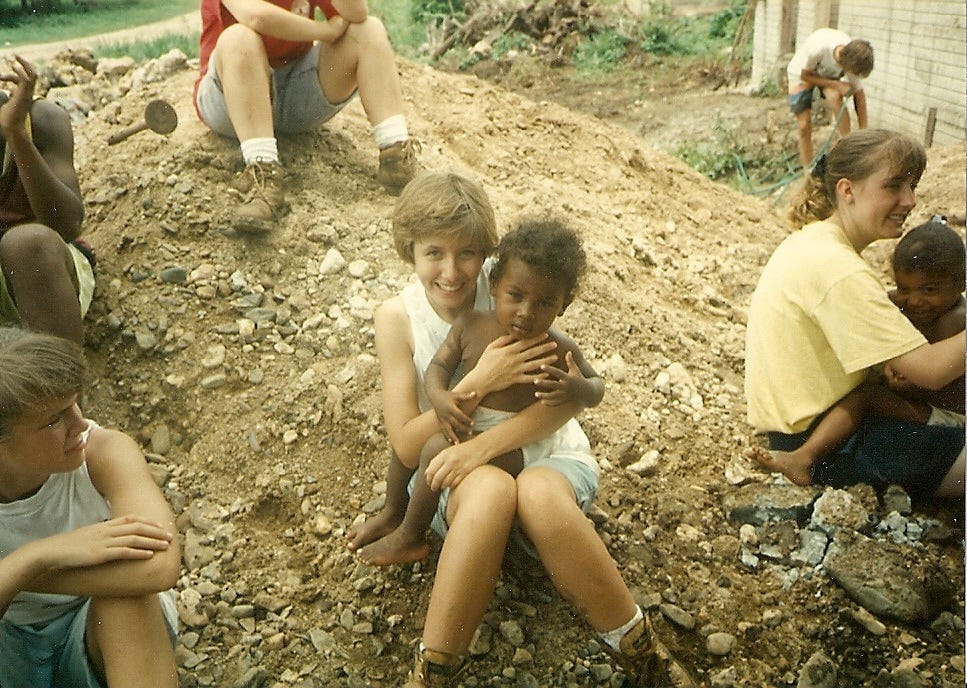
What changed was when I started naming race and systemic injustice — asking not just about individual suffering but about why certain communities bear so much of it. That’s when it got uncomfortable. And I’ve had to ask honestly — how big are we actually willing to let the Gospel be?
What Does the Text Say?
Recently, a financial supporter of my husband’s ministry asked me directly: where does the Gospel stand in your work? She was concerned that pursuing healing across social and racial lines, without explicitly proclaiming Christ, was just good deeds — temporary relief before eternal suffering, in her words. And she’s not wrong to notice something. I have been quieter about proclamation in the traditional sense. That’s been intentional — though I’m still working out why, exactly.
Part of it is the baggage. The way certain language has been used to exclude the very people I’m trying to be present to. Part of it is something harder to name — a sense that the container I was handed for the Gospel is real but not quite big enough for everything I’m encountering of God in the actual world. I’m not walking away from any of it. I’m trying to understand it more fully. And I’ve learned to be suspicious of my own need to have it all resolved before I speak. So when she asked her question — and she meant it with genuine care — I sat with it seriously, because it deserved that.
What I kept returning to was the text she herself had cited. Jesus going throughout all the cities and villages, proclaiming the gospel of the kingdom and healing every disease and every affliction. Not proclaiming, and also healing as a separate activity. The healing was part of the same sentence. Part of the same proclamation.
That grammatical reality matters. In the Gospel accounts, Jesus doesn’t finish his sermon and then pivot to medical ministry as a separate program. The healing is the announcement. When a body is restored, when someone excluded by their illness is welcomed back into community, when the person everyone had written off is made whole — that is the kingdom of God being declared present and active. The deed and the word are not competing. They are the same thing arriving in different forms.
This is why I keep coming back to the Lord’s Prayer as the center of it all. Your kingdom come, your will be done, on earth as it is in heaven. Jesus didn’t teach his disciples to pray for escape. He taught them to pray for arrival — for the reality of heaven to land here, in this world, in these bodies, in these communities. That prayer is not a wish for somewhere else. It is a declaration that this world is the place God intends to make new.
What If It Was Never Just About One Person?
There’s something else worth naming here. The framework my supporter was working from — and one I absorbed early too — is deeply individualist. Salvation as a private transaction: my sin, my belief, my eternal life. Proclamation as one person delivering that news to another person. There is truth in that. But it’s a partial truth.
The kingdom language Jesus used is inherently communal. You cannot have a kingdom with one person in it. When Jesus taught his disciples to pray your kingdom come, your will be done on earth as it is in heaven, he taught them to pray it together, and to pray it for the world. The Gospel was never only about rescuing individual souls out of a burning building. It was about the building itself — the whole created order — being made new.
What If It’s Bigger Than Rescue?
Some of us grew up in traditions that taught a very specific story about how history ends. The world gets worse. The church’s job is proclamation — get as many people to safety before the end comes. Social transformation is at best a distraction and at worst a kind of false hope, investing in a world that is already destined for destruction. I grew up near that framework. I recognize it. For a lot of people I love, it is home.
But I’ve come to believe it asks too little of the Gospel. It shrinks the good news down to an evacuation plan. And it leaves us with a Jesus who taught his disciples to pray your kingdom come, your will be done on earth as it is in heaven — and didn’t mean it.
The kingdom is not only coming. It is already breaking in. And we are invited to live as if that is true.
What If Heaven and Earth Were Always Meant to Meet?
A book that has been helping me find language for what I’ve long felt is NT Wright’s The Vision of Ephesians: The Task of the Church and the Glory of God. Wright argues that God’s plan in the Messiah Jesus was to sum up the whole cosmos in him — everything in heaven and on the earth. Not just souls. The whole thing.
He goes further: the humanity of Jesus wasn’t simply a necessity for the purposes of rescue. It was the fulfillment of the creator’s original purpose. And the true humanity of Jesus’ followers is designed to display to the world what human life was meant to be like.¹
That sentence stopped me. Display to the world what human life was meant to be like.
That’s not a footnote to the Gospel. That’s a vocation. And Wright names it plainly: the church’s calling is to live as a small working model of new creation.1
A working model. Not a waiting room.
Nowhere is this clearer than in Ephesians 2. Wright argues that the breaking down of the dividing wall between Jew and Gentile — two peoples with centuries of separation, mutual suspicion, and unequal power between them — is not simply a social benefit of the Gospel. It is the Gospel made visible. The reconciliation of divided peoples as a sign to the watching world of what God is doing.
Wright said it plainly in a recent conversation: Jesus broke down the barrier between Jew and Gentile in order to create a single new humanity out of disparate elements. This wasn’t a social byproduct of the Gospel. It was the point.2 And when the church lost sight of that vision — as Wright argues it did in the 17th and 18th centuries — it lost the theological ground to object to slavery and racial hierarchy. As he put it: “You can’t get the fruits without the roots. The roots are the Christian gospel itself.”3
And then Ephesians 3:10 takes it even further — that through the church, the manifold wisdom of God would be made known to rulers and authorities, to principalities and powers. The church’s existence as a reconciled, multi-peopled community is itself described as a proclamation. Not a preparation for proclamation. Not a nice outcome of proclamation. The thing itself.
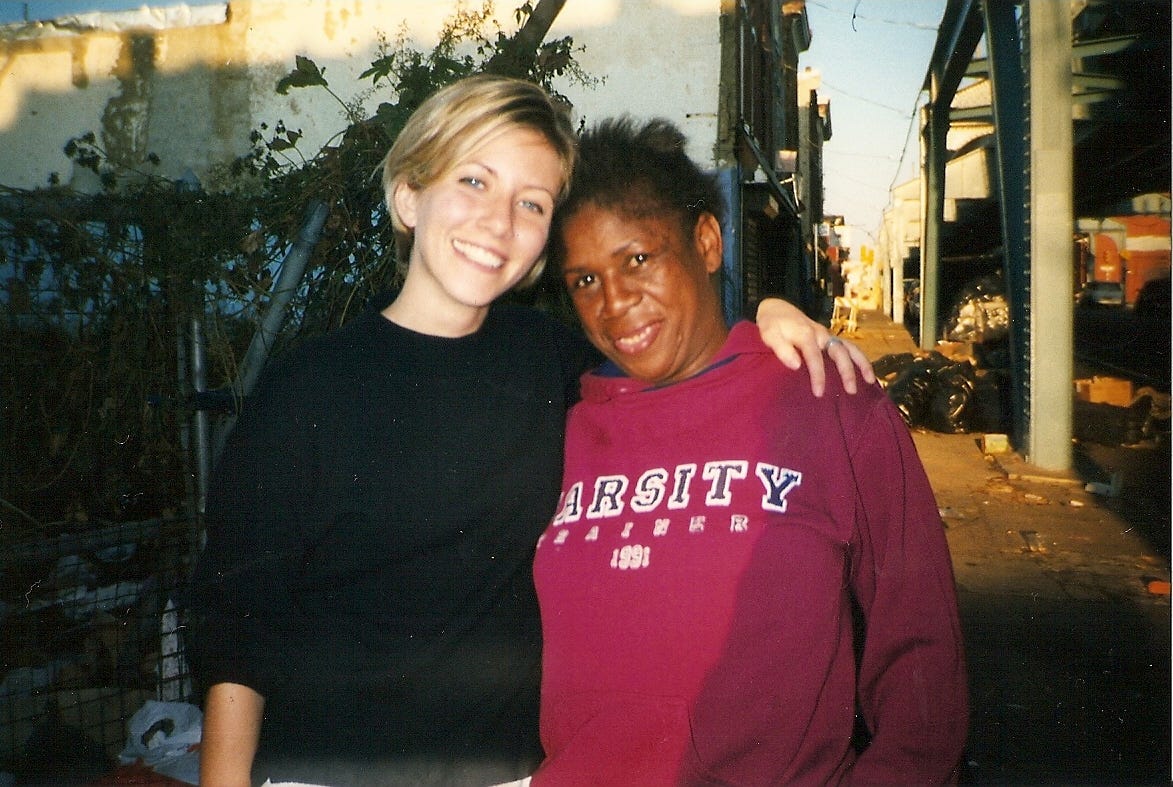
That reframes everything. A community where people across racial, cultural, and social lines are genuinely reconciled and learning to flourish together is not a distraction from the Gospel. In Paul’s framing, it is one of the loudest things the church can say.
Where Does That Leave Us?
This is where my theology has landed, and continues to land. I believe salvation is not only for the afterlife. I believe the Gospel is good news for now — that God is actively at work making all things new, and that we are invited to participate in that. When I work toward healing across racial and cultural lines, when I sit with the reality that some systems are set up to advantage some and disadvantage others, when I ask what it would look like for communities to actually flourish — I am not doing that instead of the Gospel.
I am doing it because of it.
I also want to say something about sin, because I think this is where a lot of the pushback I receive comes from. I believe sin is personal. I believe each of us is accountable before God for our own choices, our own turning away. That hasn’t changed for me.
But personal doesn’t mean only personal. Scripture is full of communal sin — the ways that whole peoples, whole systems, whole inherited structures can be bent away from what God intended. When I look at communities where disadvantage and advantage are not randomly distributed, where some people’s flourishing has been built on other people’s diminishment, I don’t see a political problem that has wandered into theology. I see exactly what happens when communities — not just individuals — turn away from the vision of the kingdom. And I believe the Gospel is big enough, and the redemption of Christ is thorough enough, to address that too.
This is not the Gospel plus something else. This is what it looks like to take the Gospel seriously in the actual world.
And If You’re Not Sure About Any of This?
I want to say something directly to those of you reading who don’t share my faith — or who have been hurt by it, which is a different and more complicated thing. Some of the people I respect most in this work are not Christians. And if I’m honest, I carry a quiet embarrassment about what the Christian witness has often looked like to them — the ways the faith I love has been used to exclude, to harm, to provide cover for the very injustices I’m trying to address. I don’t want to skip past that.
I’m not asking you to share my belief. I’m asking whether you’ve felt the pull of the same vision — that human dignity is worth defending, that divided communities can be repaired, that the world as it is is not the world as it has to be. If you have, I think we’re already in the same conversation.
What I want you to see here is a different kind of witness. Not Christianity asking you to overlook its track record, but Christianity being held accountable to its own deepest vision. That’s what I’m trying to do. I don’t always get it right. But that’s what the work is.
For me, faith is what’s underneath all of it. It’s what the work grows from. I wanted you to know that — and I wanted you to know it honestly.
In the next post I want to address something I hear often: that talking about systemic sin means blaming people for the past. I don’t think that’s what Scripture asks of us — but I do think it asks something. More on that soon.
What about you — has your understanding of faith and action evolved over time? What are the questions you are wrestling with? I’d love to hear what’s in your soil.
Would you consider joining me this summer?
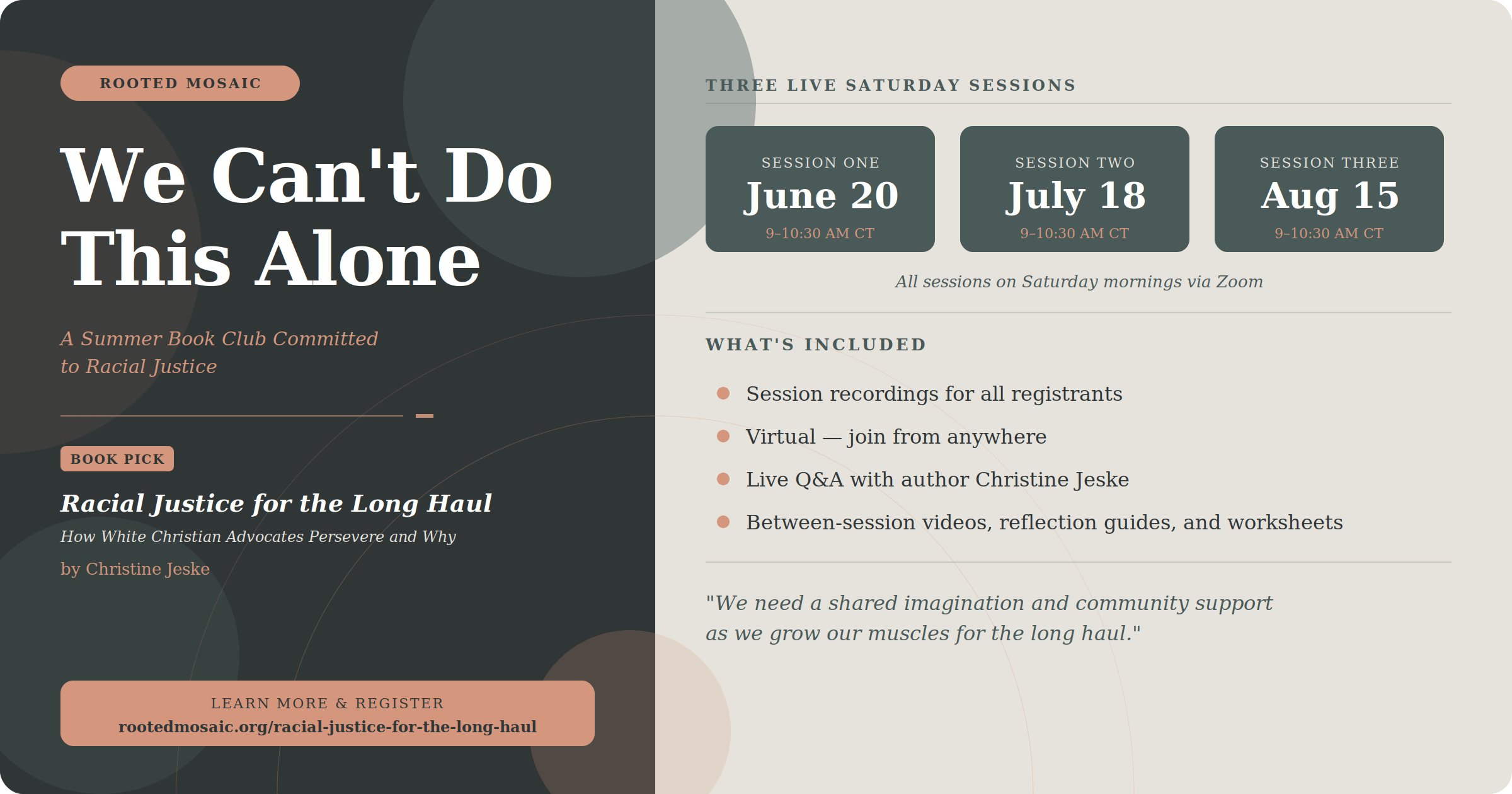
https://www.rootedmosaic.org/racial-justice-for-the-long-haul
Footnotes
N.T. Wright, The Vision of Ephesians: The Task of the Church and the Glory of God (London: SPCK / Grand Rapids: Zondervan, 2025), p. 5.
N.T. Wright, interview with TIME magazine, November 10, 2025. Available at: https://time.com/7331426/nt-wright-ephesians-christianity-interview/
N.T. Wright, quoted in “N.T. Wright: Ephesians is blueprint for multiethnic church,” Baptist News Global, October 20, 2025. Available at: https://baptistnews.com/article/n-t-wright-ephesians-is-blueprint-for-multiethnic-church/